
Ethics are for everyone except therapists
Unethical ethics and examining whose needs get to count in the psychotherapy industry.
This story begins like this:
In an effort to keep therapy affordable and manage the disparity in the fees that new therapists charge, a London-based training institute enforces a fee structure for the clinic they operate.
The new fees cap what therapists can charge based on years of practice and sit below London averages—as low as £35 per session for trainees and up to £80 for those in their first 5 years post-qualification. The news is presented as an ethical move on the part of the institute—a way to be realistic about what therapists can offer clients. The decision also claims to help new therapists build their private practice by getting referrals from the institute they trained at, but it doesn’t adjust the fees that therapists need to pay to operate at the institute. And if the alumni don’t agree to this free structure, they can go practice elsewhere.
On the surface, the announcement seems reasonable: of course, we must keep therapy affordable, especially since those who need it most can’t usually afford it.
And yet, I’m reading this email and I’m feeling dizzy. My heart is pounding out of my chest with a mix of anxiety and anger. What’s happening to me? Am I being a petulant child who doesn’t like being told what to do?
Or—maybe, just maybe—am I getting a whiff of the very power dynamics I’ve been writing about for the past two years? Could this be another familiar encounter with the shadow of money in psychotherapy, hiding itself under ethics and care?


*This essay is not a dig at my former training institute, since something similar is likely happening in most therapy schools that operate a clinic. This is an industry-wide problem that continues to remain unexamined, with (I believe) serious consequences.
Who are ethics really for
Let’s look at what role ethics have in therapy. Firstly, ethics regulate the therapeutic relationship and its inherent power dynamic, based on the asymmetry in vulnerability. Clients usually come to therapy in very sensitive states, potentially made acute by mental illness, but also make themselves vulnerable in the process by being the only ones who open themselves up emotionally.
“Ethics in psychotherapy can be thought of as a frame that defines the therapeutic relationship. The frame represents not just boundaries but also the form and expectations of the therapy, which should be decided by the therapist.”
(Ethics Commentary: Ethics in Psychotherapy, Psychiatry Online)
Second to that, ethical codes guide therapists on what it means to act in the client’s best interest. This practically translates into a form of putting the other first: prioritising the client’s needs, wishes, and safety while in practice with them.
“1. Put clients first by:
a. making clients our primary concern while we are working with them
b. providing an appropriate standard of service to our clients”
Ethical codes for therapists usually span many points (94 for BACP and 39 for UKCP, two of UK’s major accrediting bodies), covering ethical principles and a code of conduct. They also dictate how therapists should approach their work and clients, including professionalism, personal qualities therapists should aspire to cultivate, confidentiality, the importance of supervision and personal therapy, ongoing development, and more.
There’s no point arguing why these are necessary, since most of us know at least one story about how harmful it can be when a therapist breaches key ethical principles.
However, while the client-therapist relationship is paramount and should be given the utmost ethical consideration, it is not the sole relationship affecting therapy. Therapists themselves are involved in power-based relationships with their training schools and accrediting bodies—yet, when it comes to ethics, this relationship is mostly treated as an afterthought.
The therapy schools who bother to outline ethical considerations for their relationship to their students usually focus on a handful of points: how trainers should be respectful of trainees’ integrity, the importance of relational boundaries and avoiding dual relationships, and avoiding the financial or sexual exploitation of trainees. That’s… it.
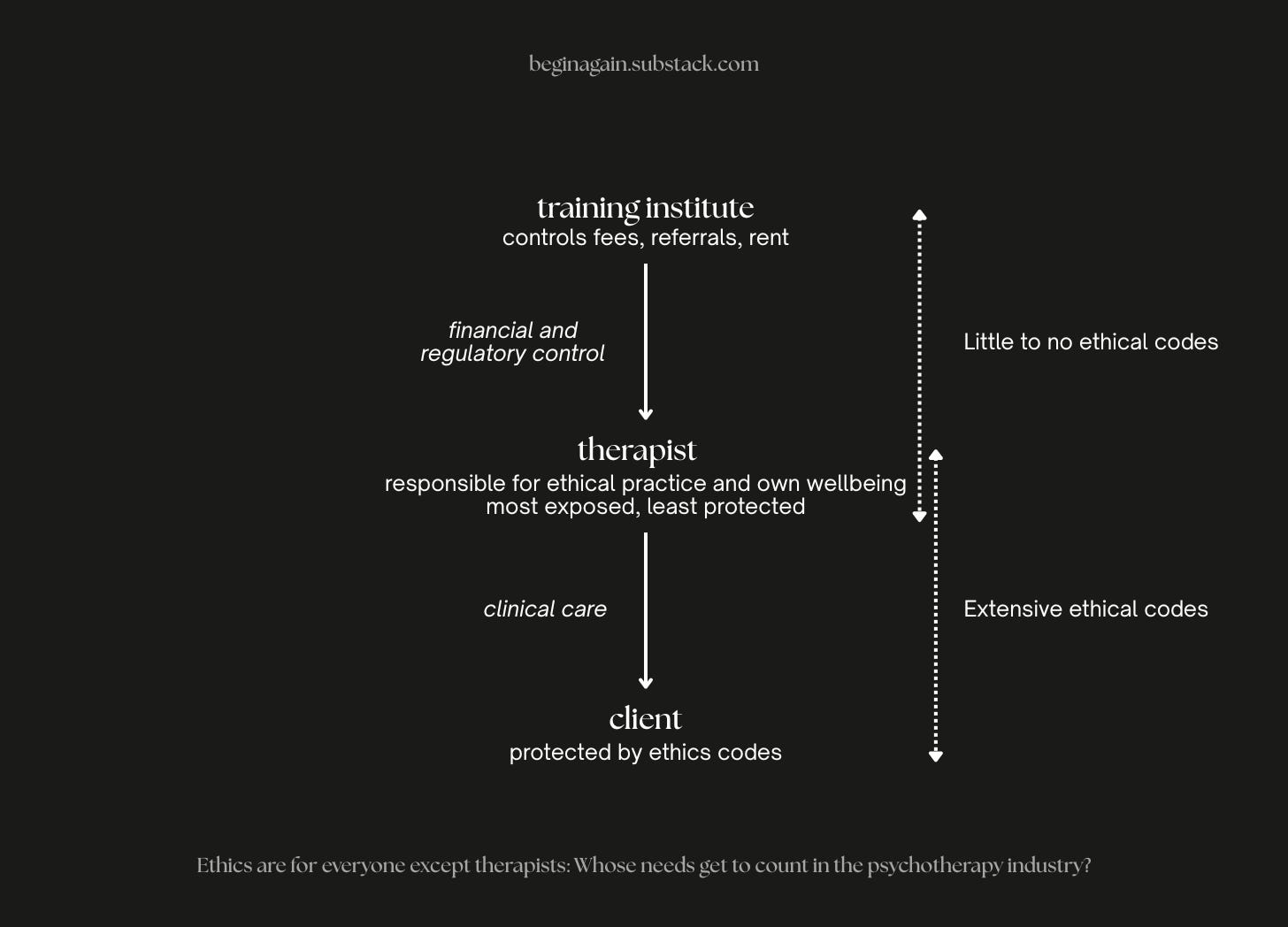
This leaves the trainee therapist in an incredibly vulnerable position, perhaps worse than the client’s.
Sitting in the middle between the training institute and the client(s) they see during their practicum, the trainee therapist has to carry both the vulnerability of an intensive therapeutic process spanning years (beyond weekly therapy there are weekend workshops, lectures that trigger personal material, group therapy) and the responsibility of putting their clients first. Due to the nature of therapy placements, the regressed, trauma-processing trainee has to work with some of the most intensive cases, without adequate training and preparation for them. The issue is compounded by the fact that the trainee is usually not paid for this work—in fact, most placements ask the therapist to pay in order to see clients.
Therefore, being caught between managing the demands of an expensive training and fulfilling the practicum required for accreditation, the trainee is left to carry the weight of providing ethical therapy at their own cost. The trainee either invests heavily in their own self-care through paying for extra supervision, massages, childcare, domestic help, time off (which may mean taking longer to graduate and start earning)—or, if they can’t afford that, they hope that they won’t get too traumatised and burnt out by the time they finish. The cost, whether financial or emotional, is entirely theirs to bear.


I thought and hoped that the story would change with qualification. Yet, the trainee’s transition into private practice is not a smooth journey. Clients don’t suddenly fill your inbox with requests for therapy and generous fees that help your body exhale after years of struggle. The dependency on the training school continues, especially when it comes to client referrals and actually earning a living. For many new therapists, getting started in private practice only reveals the shadow of money and power dynamics that the training tip-toed around.
Here’s where the ethics, however measly, run out. As an alumnus and new therapist, there appears to be no ethical code exploring the ongoing relationship to the training. The ethical responsibilities towards clients remain, yet the alumnus, still bound to the training institute through rented rooms, referral schemes, and professional identity, is no longer owed anything in return.
And so, when an institute sets a fee cap to keep therapy accessible for clients, but makes no concessions in the fees it charges fresh alumni to operate (room rent, membership fees, referral fees), it is also indirectly making a decision about how much the new therapist can earn and whether they can make a decent living from this profession.
Let me demonstrate.
The boring, but important math bit
Say you’re a new therapist, post-qualification. Although it’s incredibly unlikely (in fact impossible) that you’d immediately be running a practice of 15 people all paying between £50 and £80 (on average £65) per session and attending regularly with minimal cancellations, let’s run the numbers on that.
Assuming all clients attend all weekly sessions and you don’t get sick or need to cancel anything yourself, that earns you £4221 per month (£65 x 15 x 4.33) for your business.
Let’s also be incredibly frugal business-wise: you’re only paying for room rent (£17ph at the clinic in question, but let’s assume you only see half in person and half online, so £550 in total), supervision (let’s say an unlikely lower fee of £70 ph, twice monthly), and personal therapy (assuming your therapist charges you a student fee of £80 ph), as well as minimal annual costs of UKCP membership (£330), the training institute’s membership (£60), professional profiles on only two platforms (£239 and £245), Zoom fees for when clients need online sessions (£139), a professional will (£100), a minimal website (£200), and additional training costs (let’s go with a small budget of £3k per year—you’re not doing any fancy training like EMDR, IFS, or a degree, just small courses).
Deducting all these costs, and not considering that you also need to pay for books and courses to maintain your membership, that leaves around £2851 monthly before tax.
Now let’s multiply that by 11 months—because you’ll likely not work for a minimum of 4 weeks during Christmas, sickness, and maybe take you’ll take a week off during summer—that’s around £31k per year before tax.
So, assuming your clients never cancel a session, they all pay the maximum fee, the number of people you see doesn’t fluctuate, you take minimal time off, you don’t do any fancy training, and you don’t want to cheat HMRC, you’ll make about £26.3k per year and about £2190 per month.
Of course, reality is very different. Clients don’t attend all their sessions and don’t always stay longterm; there are family emergencies and other life situations that prevent you from working; you might choose a more expensive training; you might need to take more holidays because you have kids to entertain; summer cancellations might mean you earn half your usual; you might be paying off the loan you took for tuition (up to £30k if you borrowed the whole 5 years).
But even in the best case scenario, £2190 is not a living wage for London.
A really dramatic triangle
When such decisions are unilaterally taken by the party holding the most power, they unconsciously shape and dictate therapists’ beliefs about whose needs get to matter. In setting fees that only consider meeting clients’ needs and the institute’s financial requirements, the therapist’s own wellbeing (a necessary condition for ethical practice) becomes dissociated, discarded, or, worse, a personal failure.
Bound by ethical codes to be in good enough mental, physical, and emotional shape to practice, yet also abandoned by the same codes when it comes to their own care and protection, therapists are stuck holding what no one in this industry wants to acknowledge.
Without ethics that consider the therapist—not only superficially as a trainee, but also as an alumnus in relationship to its training institute and accrediting bodies—I don’t know if we can call therapy ethical at all. What we’re left with strikes me less as a functional system and more like the unconscious re-enactment of a drama triangle, where each party is unconsciously assigned roles that keep them stuck.
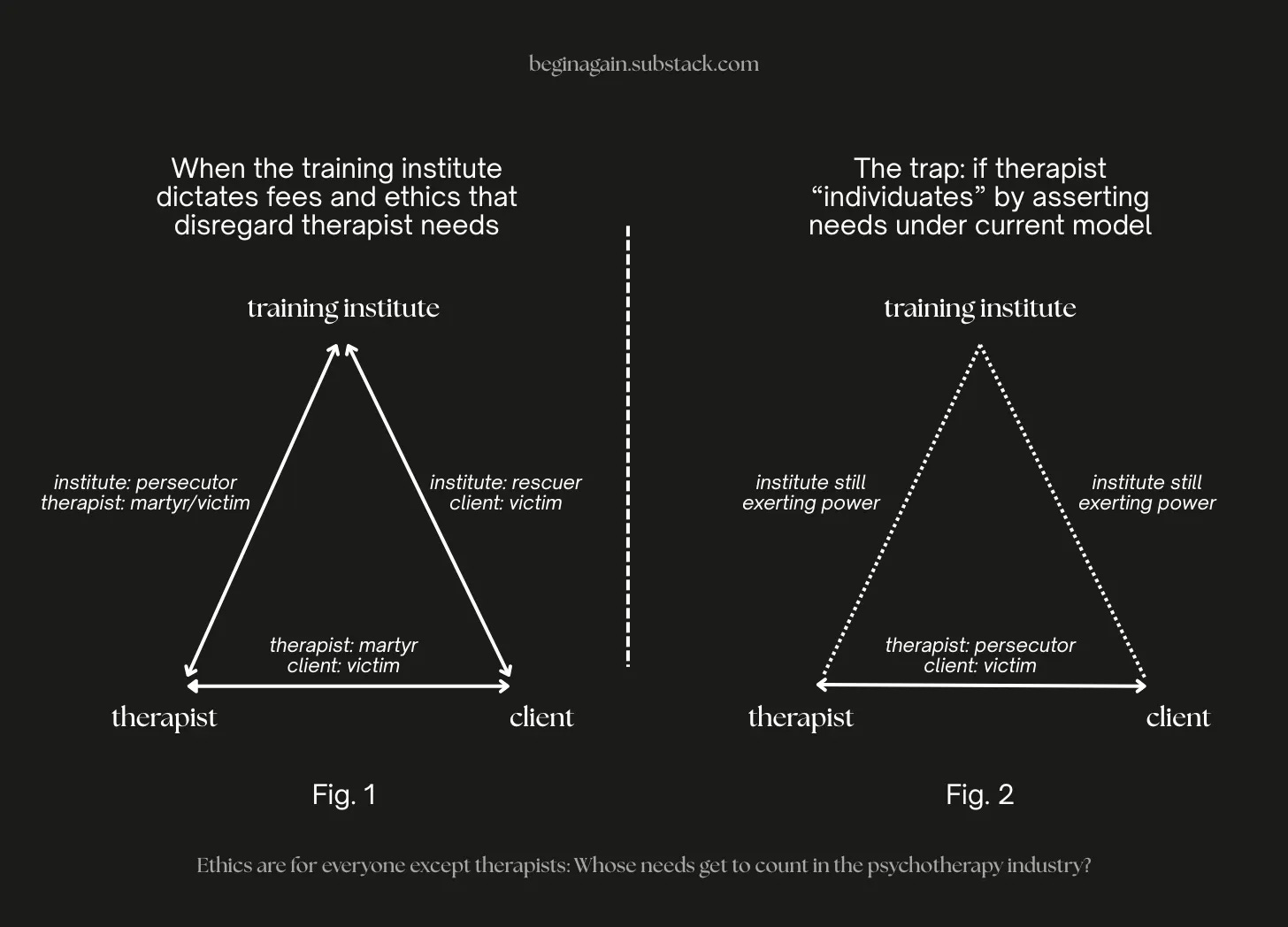
For example, in Fig. 1 we see that the institute’s attempt to contain the therapeutic practice by setting fees and ethics that only apply downwards, to the therapist, but not to itself. The institute places itself as the rescuer of the client population. I believe that this unconsciously creates dynamics where clients become victims that require saving, rather than autonomous individuals entering a relational process. Therapists thus become both martyrs who sacrifice their needs to rescue clients and victims of the ethical codes imposed on them. Because of this, the institute unwittingly takes on a persecutory role towards its own alumni by perpetuating the sacrificial relationship begun during training.
Beyond the obvious issues here, there’s also the risk that therapist begin experiencing their clients as persecutors and begin to feel resentful towards them. Not a failure on the therapist’s part, but a natural consequence of performing heavy, emotional work while personal needs go unmet. If therapists begin to feel resentful towards the institute and therapy as an industry, the risks increase. At best, they may leave the field altogether. But in worst cases they may decide to do away with ethics completely, break away from regulating institutions, and potentially harm clients.
The problem with this system is that it’s a trap. As I illustrate in Fig. 2, even if the therapist goes their own way (“individuates” from the training by practicing elsewhere, not paying membership fees), the training institute and ethical codes continue to exert power, albeit unconsciously. Using a parental comparison, since it fits the dynamics reinforced in training: you can leave home, but your parents continue to live in your head.
The therapist may independently choose their fees, but inwardly they will be haunted by the power dynamic they internalised during training and after. By charging clients more in order to prioritise one’s own needs, the therapist may feel like a persecutor (and may even be judged so by colleagues) towards clients, depriving them of needs by taking their money. Within this framework, the client still remains in the position of victim—which, I believe, hurts the therapeutic relationship by infusing it with hidden dependency, need, guilt, and shame.
Conclusion: whose needs get to matter?
To transcend this triangle, I believe that the therapist’s development from dependent, regressed trainee to full practitioner-alumnus, expected to make a living and maintain ethical standards deserves much more thought than it’s currently being given. Ethical codes need to be expanded to address all relationships involved and how they impact each other.
If training institutes maintain financial relationships to alumni by charging membership fees, setting fee caps, offering referrals, or even dictating what ethical practice looks like, then these actions cannot be overlooked as neutral when it comes to power dynamics. Money continues to dictate not only who gets to train as a therapist, remain a therapist, and see a therapist. It remains an unexamined taboo—and taboos are exactly where power dynamics go to thrive.
It’s no surprise that my heart started pounding when I read about the fee cap. Beneath the seemingly reasonable, ethical considerations behind the announcement, my body recognised the same unexamined shadow that followed my training as a therapist and that I carry through daily in my client work as I attempt to integrate my needs into this work. How can I reconcile my need for belonging to my former training with my need for having a decent life? Why do these two have to be at odds with each other? Why aren’t therapists a priority for the place that told them how important their mission was?
And, most importantly: can we build ethical models that hold enough space for all three parties in the room: client, therapist, and institute alike? Whose needs get to matter in this work, and why?
A provocative exploration of these complicated topics, thank you, I was absorbed as ever!
Thought provoking, as always. Thanks Maria