
Fate, destiny, and individuation
Christopher Bollas, psychoanalysis, and the missing half of Jungian psychology
Some exciting announcements before we get into the essay:
If you’d like to dive deeper into the fascinating ideas in this essay, I’m teaching a live seminar about these key concepts of Christopher Bollas on Thursday, 25 June at 6:30pm—you can register here.
There’s been a lot of interest for a new dream group this summer. 8 consecutive Thursdays, 7-9pm BST, dates TBA. Get in touch if you’d like to apply.
I’m trialing community dream walks this summer in London: lightly facilitated, gentle walks, all about appreciating dreams and making meaningful connections.
As a naturally introverted intuitive, I don’t need to be told twice to hide in my room and meditate. I’ll happily skedaddle from any event to my bedroom and write down my dreams, paint images from my visualisations, draw tarot cards, and get lost in my imagination. My inner world is incredibly rich and carries so much feeling that I often find the outer world a bit... underwhelming.
Of course, that’s not entirely true. If you’re an introverted intuitive like me, you might also recognise the whispers of defence in my statement. The outer world is, of course, just as rich and unknown as the inner one. But while I’ve gained some mastery over my inner world, I’m not sure I’ve had the chance to do the same in the “real” world. I can encounter my animus in dreams—but am I as self-assured when I meet him out there? That remains debatable.
This is the golden trap and shadow of Jungian psychology. Jung uses mythopoetic language to talk about the call to individuate and warns of the psychic death that happens when we don’t answer it. He gives us a treasure map into the unconscious, yet I’m not sure how well he maps the return.
This is where psychoanalysis offers a course correction. The royal road is in fact the same: both aim to meet the unconscious. But while Jungian psychology inevitably implies an inevitably introverted descent into the psyche for its encounter with the unconscious, withdrawing from the world to meet our inner figures, psychoanalysis demands that we remain real and engaged in the outer world. One pulls us within; the other shows us that the way can also be without.
Perhaps the split between the two is the remaining unresolved tension that, too caught up in their narcissism, Freud and Jung couldn’t resolve. But the more psychoanalysis I read, the more I recognise how much we need both. To truly answer the call, we have to bridge the gap between Jung’s inward personal myth and what Christopher Bollas calls the human idiom.
The human idiom and the destiny drive
“The idiom of the person is not, however, a hidden script tucked away in the library of the unconscious waiting for revelation through the word. It is more a set of unique person possibilities specific to this individual and subject in its articulation to the nature of lived experience in the actual world. The life of the true self is to be found in the person’s experiencing of the world.”
Christopher Bollas, “Forces of Destiny”
Like Jung, Bollas believes that each human comes into the world with a certain blueprint. Jung called this the personal myth: the arc your individuation journey takes as you confront and integrate the unconscious. As I understand it, this myth describes the way you experience the archetypes throughout your life and how the Self, the central and totality of the personality, invites you to actualise more of your potential.
Looking at how Jung discovered his own personal myth through his mystical descent into the underworld, we can see that this is essentially a very inward, private journey. The Red Book is not a diary of affairs, travels, or fancy dinners—it’s pure katabasis, ego death, followed by the resurrection of the personality. And that’s the key part of individuation: the personality must confront its center, likely through a crisis, and fundamentally shift the way it relates to the greater unconscious. The ego no longer rules the show, but becomes a wise servant for the Self.
Where Jung modelled a solitary retreat into his Bollingen tower, akin to the journeys of old mystics, psychoanalysis appears to recommend exactly the opposite. The human idiom does not appear as a blessed vision in meditation, away from the world—it is cultivated through living intensely within it.
What Bollas appears to suggest is that our idiom unfolds as we rub up against experiences and other people, as much as our inner world. Yes, there is reflection and introspection (after all, you’re sitting with your analyst five times per week!), but the bulk of the work is done by… living! The human idiom reveals itself through being an active participant in life and letting it change you.
Thus, our choice of objects (whether they are friends, partners, books, movies, jobs, travel destinations etc.) is the reflection of our idiom. Desire guides us towards the articulation of our True Self by directing us towards what will transform and release our potential, and away from what does not resonate with our idiom. Desire is the expression of the destiny drive—the urge to come into our own being, to become real.
Of course, the two approaches are not incompatible. Their separation is likely a vestige of the unresolved conflict between Jung and Freud—one that, once you dig more into, appears to be less of a disagreement on theory, and more of a narcissistic pattern of relating. But the personal myth and the human idiom can exist and interact on a continuum of experience between the inner and the outer. They are likely articulations of the same pattern—one describing the ego’s relationship to the unconscious, and the other the ego’s relationship to the world (also unconscious).
Fate vs destiny
“To be the object of the fates is another way of talking about being the object of parental injunction.”
Christopher Bollas, “Forces of Destiny”
I have to confess that I wasn’t very clear on how fate and destiny occupied different planes of experience—how they diverged as two karmic paths, fundamentally serving different purposes and meanings.
Bollas brilliantly identifies a key differentiator that I find helpful: fated people live with images of the future that carry a feeling of familiarity and despair. Although they might not realise this, the futures they imagine are, in fact, memories that repeat in a samsaric cycle, taking on new clothes, but essentially articulating the same wounds and defences.
Most importantly, they live false lives, which they may or may not be aware of. Even as adults, their choices seem to be made for them, rather than by them—a repetition of the parents’ early failure to recognise the child’s True Self and facilitate its incarnation by providing the right experiences and objects. Thus, life feels as if it’s continuously disrupted by fated events, similar to the parents’ disruption of the True Self seeking to emerge, but being forced to adapt to the parents’ narcissistic needs and wishes.
Their lives are largely reactive, as they haven’t yet discovered the creative power of their true self. If they get glimpses of their authentic desires, they’re likely haunted by oracular voices that predict unhappy outcomes, catastrophe, or a lack of worth. They don’t always recognise that their inner world has been invaded by the limiting voices of their mother, father, or other persecuting figures (including those of society).
Having worked with many fated people in my practice, I recognise a compulsivity that drives their choices. At first, it was maddening to watch them repeat patterns we had spent weeks, sometimes months unpacking: getting back with the abusive ex, idealising a new partner, running back to a parent who will hurt them again, or blowing up a relationship when the discomfort felt too intolerable. I would often feel desperate to get them to realise what’s happening and rescue themselves from the pull of the past. It rarely worked—I would exhaust myself mentally trying to find the right words, the right tone, and just the right timing to get through to the True Self within. Those sessions felt as tense as a terrorist negotiation and most of the time ended with clients getting upset with me or even leaving therapy. As I’ve grown in experience, I like to think I’ve learned that as a therapist, my role is not to fight the fates, but to catch people when fate inevitably does its tricks.
Destined people, on the other hand, live with a sense that they are creating their lives. They feel freer to make choices and follow their desires. They choose environments that facilitate their authentic self, even if that pulls them away from familiar places of comfort. Unlike the compulsive fated person who reacts to life, a destined person acts with a sense of drive and assertiveness. They may also hear the siren call of the past, but they have developed enough connection to Self to steer away from its regressive pull and choose differently.
I love living through a destined moment with a client. Stimulated by a dream, a person, or an event, it’s like a new space opens up. There may well be fear and hesitation, but the person recognises that there’s something here for them—that, even though they don’t quite know how, this will somehow transform them, rather than reconfirm something they already believe about themselves.
“The destiny of any of us then is more than slightly determined in advance. A deja-vu, the sense of having lived precisely this event before, may be an existential signature of the recurring resonance between the dream and the future, as some of our action experiences will have been dreamt before.”
Christopher Bollas, “Forces of Destiny”
From my own experience, following that destiny drive (which, for me, often arrives in dreams) hasn’t exactly spared me any suffering. It has still mercilessly thrown me in the arms of fear and rejection and sadness. But it has also shown me the difference between growth pain and pain that simply repeats itself. In fact, my sense is that many times fate and destiny coexist, like two sides of the same coin. The moment of choice feels like a threshold between two alternative selves and realities—memories and futures; False Self and True Self; or, in Jungian terms, a complex and the Self.
And perhaps our own response to the choice, what meaning we make of the outcome, is what can differentiate between a fated moment or the destiny drive; between regression and individuation.
Ruthlessness vs receptivity
“People who have a sense of destiny also invest psychically in the future. This involves a certain necessary ruthlessness and creative destructiveness, of the past and the present, in order to seek conditions necessary for futures.”
Christopher Bollas in “Forces of Destiny”
So how do we step out of the samsaric cycle of fate and into the destiny drive? How can we fuel our individuation in a way that honours the inner world, while also recognising that the friction with the outer world is where the True Self is forged?
Here Bollas offers an unexpected direction: ruthless pleasure and aggression.
To articulate the destiny drive, we must become ruthless in our choices. To come alive, we must say no to what does not bring us closer to our vision of the future. We must be willing to disappoint and lose important, even valuable things, if we want to serve our individuation—to destroy what is no longer generative and to turn away from what doesn’t excite us. And we must allow ourselves to make use of the objects in our lives without unnecessary worry that we may damage them beyond repair.
For example, staying married to the childhood sweetheart may be lovely and comfortable, but may not provide the tension, raw passion, or healthy challenge you need to articulate the new parts of you that need to emerge. Staying in a prestigious job that pays well but bores you will serve your security needs and make people nod approvingly when you introduce yourself at parties, but will starve your need for purpose. Having a child can fulfil a need for meaning and deeper love, but may also be a clever, cowardly escape from discovering one’s own creative self first.
There’s a healthy aggression that comes with following the destiny drive. While Bollas leaves room for compromise and adaptation, he is fundamentally advocating for a life lived with full participation. This requires choosing people, experiences, and objects that bring aliveness and transformation, that challenge us to become real, rather than what popular culture deems as people-pleasers. And I think it also demands that we expect our lives to be, in most respects, enjoyable.
This is not something Jung gave much thought to. In classical Jungian psychology, objects are not necessarily sought out, but constellated. In our inward descent, we sometimes experience moments where objects in the outer world resonate with inner experiences—we call this magic synchronicity and we take it as a meaningful coincidence articulating what Bollas might describe as the destiny drive. A book magically opens on an image from our recent dream; a song pops on with lyrics that speak precisely to what we’re currently processing. We do not intentionally move towards the book or song; we receive them by remaining open to the unconscious.
Even though I have a strong preference to the Jungian way, I find Bollas’ take incredibly stimulating. Where Jung invites me to dream and take pleasure in my inner world, Bollas reads like a double-shot of espresso reminding me that life is (also) out there. His writing reminds me that, no matter how well we know our inner figures, we are not integrated until we find a way to live amongst (ugh…) others.
Could this is be not a question of introversion or extroversion, but rather an invitation to be honest? Are you truly living, or merely rehearsing life? Are you choosing your life or is something else choosing for you?
Are you being ruthless enough with your one and precious life?
“Perhaps the creativity of a human lifetime is the talent in articulating one’s idiom.”
Christopher Bollas, “Forces of Destiny”
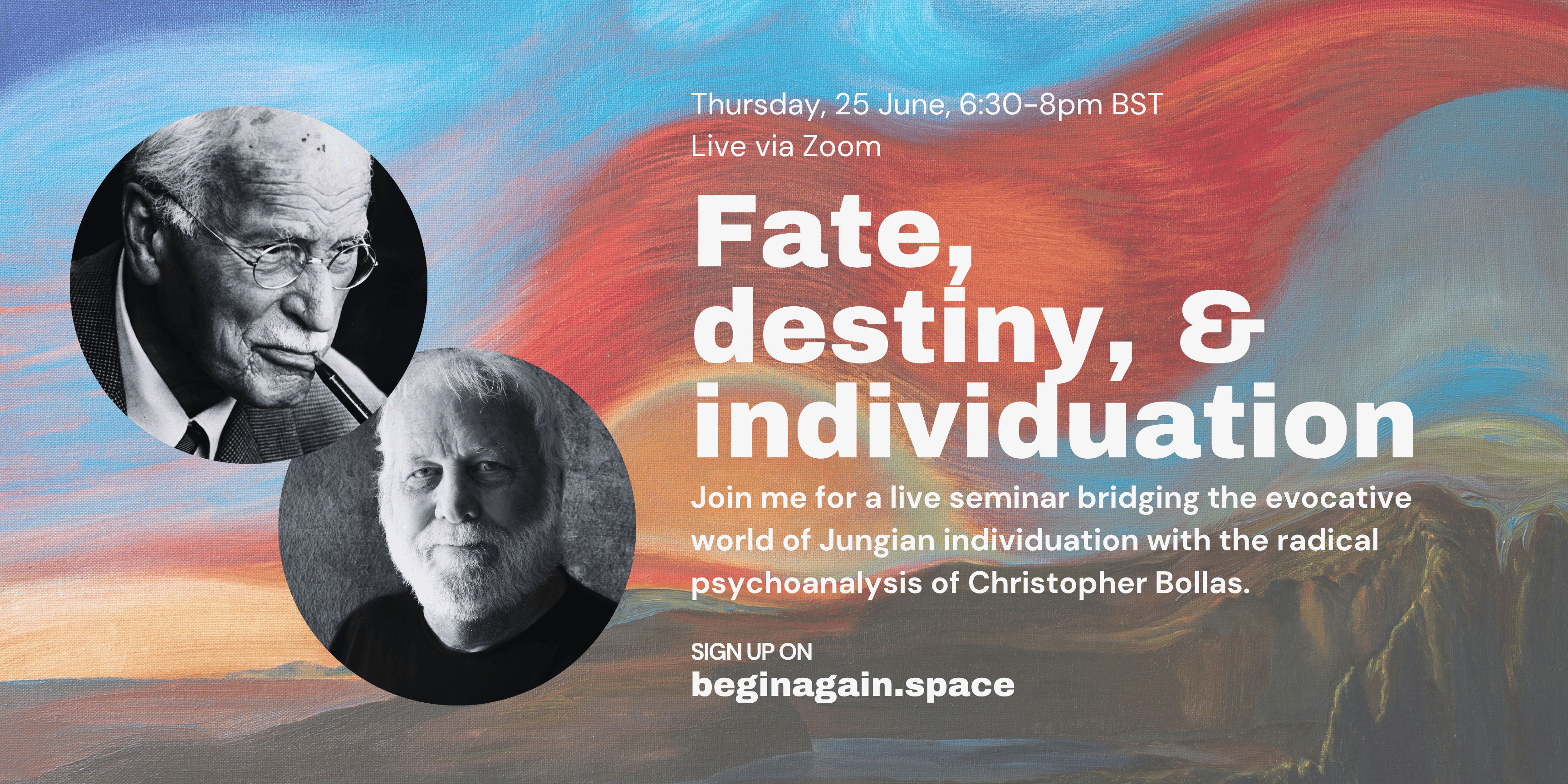
Thank you for reading. If you enjoyed this essay, join me for a live seminar where I will expand on this idea through Christopher Bollas’ key concepts, while drawing parallels to Jungian psychology. There will be space to think through these ideas together and reflect on how they show up for you. Tickets are £20 standard and £10 only for paid subscribers (£5 cheaper including the monthly subscription). Sign up here.
Interesting, I wasn’t aware of Bollas. This reminds me of the invitation of “ how do I live that? “ , once you encounter an insight from the unconscious (was it Rilke who said that? I know jungians use it, especially James Hollis ) . The question is an invitation to go out into the world and use it. I like the directive of “healthy aggression” to activate it.
Thank you for this post Maria. Bollas sits gathering dust in a OneDrive folder of PDFs. Maybe one day I will get there.
He does sound quite Jungian though. Especially in your framing of fated and destined life. I think discovering one’s personal myth helps tremendously, but even still the challenge becomes maintaining a certain individuated living from that recognition. No easy feat!